September 28, 2007

Starlac Powdered Milk

Every week the news seems to bring a new food recall to our attention. Even pet food isn't exempt.

I hate it when a product that I use is recalled because the recall and all the details seem to forever linger in the back of my mind. It's rather irrational on my part, as the problem is usually corrected, but sometimes it will take years for the memory to fade before I trust a brand enough to start buying it again.

For years I have fed my cats a nationally known brand of prescription cat food. Although one variety of this brand was recalled, the variety I use was never on any of the recall lists. I became extremely uncomfortable about using this product because it seemed that my cats did exhibit a few of the symptoms listed. The fact that the company began selling a reformulated product shortly afterward only intensified my discomfort despite the manufacturer assuring me that the new food had been in the works for some time.

Honestly, I can't make myself believe them. I'm not a marketing expert, but it seems to me that this was a very bad time to introduce a reformulated product when you didn't have to. So now the perception I have, justified or not, is that they may not have been as truthful as I would have hoped.

The product advertised in the recipe brochure that I chose today was associated with a product safety recall in 1966.

Starlac was the brand name of the powdered milk sold by Borden's from the early 1950s to the mid-1960s. It was sold in several different sizes ranging from individual pre-measured 1 quart packets to a 12 quart economy size.

New Recipes for Completely New Super Starlac (undated, foldout) was one of several recipe brochures featuring the Starlac product that was published during this time period.

Borden's advertising proclaimed that Super Starlac was "quicker than instant" and that their modern new "hearts of milk" dissolved faster than other products using crystals and powder, which Borden's now deemed to be "old-fashioned".

A voluntary recall in 1966 because of the possibility of salmonella bacteria contamination along with the associated negative publicity is what caused the demise of the Starlac brand of powdered milk. The brand never recovered due to the erosion of public confidence in the product.

Since the brochure is not dated, I am left to wonder if Completely New Super Starlac was an attempt to salvage the public perception of the brand and to regain consumer confidence.

Below is a recipe from the brochure which is similar to those you will find for an Orange Julius. Since Starlac no longer available, you could substitute any brand of powdered milk.

ORANGE CHILLER

(Makes 4 large servings)

1/4 cup frozen orange-juice concentrate, thawed
2 tablespoons honey
1/2 cup crushed ice
1 quart liquid Super Starlac, chilled

Combine orange-juice concentrate and honey in large pitcher; add crushed ice. Blend in liquid Super Starlac. Serve.

Labels: , , , , ,

August 30, 2007

Miss Hulling's Mac 'n Cheese

Upon first glance, Prize Winning Recipes (1960, 32 pp.), a small recipe booklet published by American Beauty Macaroni and the Durum Wheat Institute, looks like nothing much more than a collection of macaroni and pasta recipes.

There are several pages devoted to the nutritional value and proper cooking methods of durum macaroni foods. Durum is a special variety of wheat used in producing pasta. The booklet explains that macaroni products made from durum retain their shape and firmness while cooking and do not leave a starchy residue in the cooking water. They say that it resists the common tendency of non-durum products to cook up mushy.

These recipes have been designated as "restaurant-tested" for your home which, I guess, is supposed to make them more appealing to homemakers.

These recipes came from well-known restaurant or quantity food service kitchens and were collected by Miss Albert M. MacFarlane, a food consultant. A first presentation of the series was made at the annual Food Show of the National Restaurant Association in Chicago. Then, family-size versions were developed in the test kitchens of the Durum Wheat Institute. These family-size versions are the ones you will find in this booklet.

It's the fine print of the captions underneath the photos that makes the booklet intesting. Looking closely you will find that some of these prize-winning recipes were from establishments well-known for their great food. Many of them are no longer here, lost to the passage of time and a proliferation of McRestaurants. Whether or not any of these dishes ever made it to the restaurant dining rooms, I don't know, but a chef is a chef, and their creative talents are usually evident in whatever recipes they come up with.

Here are a couple of recipes from places that you might find familiar:

The first is a contribution from Florence Hulling Apted of Miss Hulling's Cafeterias in St. Louis, Missouri. The Miss Hulling's Cafeterias are gone now, but many people still seek out Miss Hulling's recipes. Is this dish reminiscent of one served in her cafeterias? I don't know, but it's the way I prefer to prepare my own mac 'n cheese--with cheese in the sauce as well as a generous amount melted over the top.

MACARONI AND CHEESE
1/4 cup butter
1/4 cup enriched flour
1/2 teaspoon salt
3 cups milk
1/2 cup grated cheddar cheese
8 ounces elbow macaroni
1-1/2 cups grated cheddar cheese

Melt butter in large saucepan. Blend in flour and salt. Gradually add milk, stirring constantly; cook until sauce is thickened. Add 1/2 cup grated cheese and stir until melted. Cook macaroni in boiling, salted water until tender. Drain. Add to Cheese Saue and mix well. sprinkle top with 1-1/2 cups grated cheese. Bake in moderate oven (375 degrees F.) about 15 minutes. Remove from oven and place under broiler until cheese is bubbly and lightly browned.
Makes 4 to 6 servings.

********************
The next recipe comes from The Parker House in Boston, Massachusetts. You know the place--the one that's famous for their Parker House rolls and Boston Cream Pie.

CASSEROLE OF CREAMED LOBSTER AND MACARONI
2 cups lobster meat (2 cans, 6 ounces each)
1/4 cup butter
1/3 cup butter or margarine
1/3 cup enriched flour
2 teaspoons salt
1/4 teaspoon pepper
2-1/2 teaspoons paprika
3-1/2 cups milk
1/3 cup sherry wine
8 ounces elbow macaroni
1/2 cup grated Parmesan cheese
1/4 cup melted butter

Cut lobster meat in small pieces. Saute in 1/4 cup butter. For sauce, melt 1/3 cup butter or margarine in large saucepan. Blend in flour, salt, papper and paprika. Add milk gradually, stirring constantly; cook until thickened. Add lobster meat and sherry wine. Cook macaroni in boiling, salted water until tender. Drain. Add macaroni to lobster mixture. Turn into lightly greased 2-quart casserole. Sprinkle top with Parmesan cheese. Pour 1/4 cup melted butter over top of casserole. Bake in moderate oven (350 degrees F.) until sauce is bubbly and cheese is melted and delicately browned, 20 to 25 minutes. Makes 4 to 6 servings.

It's shown in the picture served with a Parker House Roll and a mixed green salad.

***********
Other recipes and places found in the booklet are:

Mexican Macaroni Casserole: prepared by Alma B. Atkinson - Teachers College, Columbia University, New York, NY
Casserole of Ham, Macaroni and Broccoli: as prepared by Patricia A. Beezley, Pennant Cafeteria, Topeka, Kansas
Creole Spaghetti Stew: as prepared by Margaret E. Terrell, University of Washington, Seattle, WA
Baked Chicken and Noodle Casserole: as prepared by Gertrude Allison Brewster, Olney Inn, Olney, Maryland
Casserole of Noodles, Chopped Steak and Tomatoes: as prepared by Beatrice Hughes Hofsommer, the Harding Restaurants, Chicago, IL
Baked Salmon and Shell Macaroni Au Gratin: as prepared by Annabel Combs, Damon's, Cleveland Heights, Ohio
Mexican Spaghetti: as prepared by Ruby Clark, Department of Institution Management, Purdue University, Lafayette, IN
Macaroni Loaf: as prepard by Winning S. Pendergast, School Lunchrooms, Detroit Public Schools, Detroit, MI
Macaroni Salad: as prepared by Gertrude Brammer, L.S. Ayres & Company, Indianapolis, IN
Casserole of Chicken Kalakaua with Macaroni: as prepared by Executive Chef Paul Koy, Royal Hawaiian, Honolulu, Hawaii
Spaghetti Supreme with Mushroom Sauce: as prepard by Raph B. Smith, The Grace E. Smith Company, Toledo, Ohio
Spicy Oyster-Spaghetti Casserole: as prepared by Chef Bramon, Netherland Hilton Hotel, Cincinnati, Ohio
Chicken, Mushrooms and Noodles with White Wine Sauce: as prepared by Chef Bramon, Netherland Hilton Hotel, Cincinnati, Ohio
Casserole of Seafood and Noodles Au Gratin: as prepared by Louise Nabel, Frances Virginia Tea Room, Atlanta, Georgia
Noodle and Chicken Campanini en Casserole: as prepared by Armando's Restaurant, Chicago, IL
Chicken Livers Hunter Style with Buttered Noodles Polonaise: as prepared by Chef Diciero, Terrace Hilton Hotel, Cincinnati, Ohio
Spaghetti with Clam Sauce: as prepared by Vincent and Tony Bommarito, Tony's, St. Louis, Missouri
Spaghetti Tetrazzini Armando: as prepared by Armamdo's Restaurant, Chicago, IL
Angelo's Italian Spaghetti with Meat Balls: as prepared by Angelo Arata, Angelo's Restaurant, Concord, New Hampshire
Spaghetti Tetrazzini Mayfair: as prepared by Erice Nielsen, Hotel Mayfair, St. Louis, Missouri
Spaghetti Marinara: as prepared by Vincent and Tony Bommarito, Tony's, St. Louis, Missouri
Veal Lasagne: as prepared by Leila Colwell, Evanston Hospital, Evanston, IL
Mostaccioli with Rich Tomato Sauce: as prepared by Armando's Restaurant, Chicago, IL

If you think you might like a copy of this booklet for yourself, you can probably find one here.

Labels: , , , , ,

March 26, 2007

A Handi-Book of Meat Cookery

Like her counterpart Betty Crocker at General Mills, Martha Logan was the fictional corporate spokeswoman for the meatpacking giant Swift & Company. Under the guise of Martha Logan, Swift's staff of home economists dispensed advice, recipes and tips to consumers from Swift's Chicago office, on radio shows and in cooking demonstrations across the country. Many women had jobs as a Martha Logan over the years when the various promotional situations called for a live person.

Martha Logan's Meat Handi-Book (1968, 16 pp.) was only one of the many Martha Logan promotional booklets published by Swift & Company. The booklet was designed to help consumers choose and cook their meat properly.

As in many of the Swift & Company cookbooks, a short personal note from Martha Logan is found inside the front cover:

"Hi--Meat Makes the Meal--if it's cooked properly! The fame of each cut of meat depends upon the way you cook it! For instance, a Swift's Premium Porterhouse Steak would be quite tasteless if it were braised and a low-grade round steak would be unchewable if it were broiled.

I hope this booklet will help you treat each cut right.--Martha Logan"


The booklet is made up primarily of tables and charts with no other illustrations save the one on the front cover. While similar information may be found in other cookbooks, the tables in this booklet include not only generic cuts of meat but also specific cuts and brands produced or packed by Swift such as Swift's Premium Corned Beef Brisket and Swift's Georgia Peanut Cook-Before-Eating Ham.

One chart shows the drawings of the bone shapes of beef, veal, pork and lamb, divided into tender (T-bone, rib bone, wedge bone and round bone) and those less tender (blade bone). This chart is meant to help you identify a cut of meat and predict tenderness.

Other charts and tables found inside were the Refrigerator Storage Time Chart, Freezer Storage Time Chart, Roasting Schedule for Fresh Meat, Roasting Schedule for Cured and Smoked Pork, Roasting Schedule for Poultry, Braising Schedule for Meat, a Water Cooking Schedule and a Broiling Schedule.

Short discussions on the storage methods and preparation of different types and cuts of meats and poultry are included, as well as instructions on how to use a meat thermometer.

Labels: , , ,

January 22, 2007

Bisquick Velvet Crumb Cake

The Food Companies often include recipes on their product packaging. That's where some of the best recipes come from. On some produts these recipes stay the same and on others they're rotated fairly frequently.

The Campbell's red and white soup cans always have recipes on the labels and they're examples of package recipes that rotate quite often. Don't take them for granted. Sometimes you never see them again!

I can remember my mother preparing a skillet dish called Meatballs and Rice off the back of the Campbell's Onion Soup label when I was in the fifth grade. (I remember that I was in the fifth grade because that was the year we had a house fire and my fishnet stockings burned up AND I had a broken arm from roller skating. A traumatic time that was, losing all my fishnet stockings like that.)

Anyway, I remember my mother cooking this at the loaner apartment--and, coincidentally it's also the first time I noticed her using a recipe off the can (did her cookbooks burn up along with the stockings?). So time goes by and I'm cooking for myself, and I'm searching for that recipe. To this day, I have never been able to find that recipe that was on the can in 1968, not anywhere.

The Bisquick box is an example of one whose recipes mostly stay the same (thank goodness!) The boxes always have the recipes for pancakes, waffles, strawberry shortcake, biscuits and dumplings. If they ever took the dumpling recipe off the box I wouldn't be able to make Chicken and Dumplings. (That's stretching it--I did clip the recipe many years ago, but it's easier to just look on the box.) I know it's simple, but it's always THERE so I don't have to remember it or look for it anywhere else. They do sometimes feature other recipes, which is okay as long as they leave the old regulars on there along with the new ones.

I had an inquiry tonight from someone looking for the Bisquick Velvet Crumb Cake recipe. That one used to be on the box too, but I guess they finally took it off.

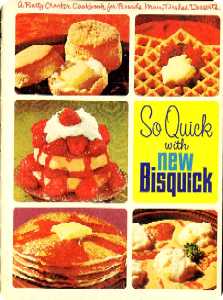
She had clipped hers, but had lost the clipping. So I found it for her in the So Quick with New Bisquick (1967, 2nd Edition, 120 pp) cookbook.

Notice that this particular recipe calls for New Bisquick (they reformulated it in the 1960s), but I just use the Original Bisquick now. Later printings of the recipe just call for plain old Bisquick.

BASIC RECIPE FOR VELVET CRUMB CAKE

1-1/2 cups New Bisquick
1/2 cup sugar
1 egg
1/2 cup cold water or milk
2 tablespoons shortening
1 teaspoon vanilla

Heat oven to 350 degrees. Grease and flour a square pan, 8x8x2 inches, or a round layer pan, 9x1-1/2 inches. In large mixer bowl, blend all ingredients on low speed 1/2 minute, scraping side and bottom of bowl frequently. Beat 4 minutes on medium speed. Pour into prepared pan. Bake 30 to 35 minutes or until top springs back when touched lightly. If desired, while warm spread cake with Broiled Topping (below) or other topping.

BROILED TOPPING

Mix 3 tbsp. soft butter, 1/3 cup brown sugar (packed), 2 tbsp. light cream, 1/2 cup coconut and 1/4 cup chopped nuts. Set oven control at broil and/or 550 degrees. Place cake about 3 inches from heat; broil about 3 minutes until mixture is nicely browned.

Note: 9-inch square pan can be used. Bake cake 25 to 30 minutes.

Variations:

VELVET CRUMB CAKE WITH BROILED PEANUT BUTTER TOPPING

Prepare Velvet Crumb Cake from basic recipe. While warm, spread cake with Peanut Butter Topping (below). Set oven control at broil and/or 550 degrees. Place cake about 3 inches from heat; broil about 3 minutes or until mixture is nicely browned.

PEANUT BUTTER TOPPING

In small bowl mix thoroughly 2 tbsp. soft butter, 1/3 cup brown sugar (packed), 2 tbsp. milk or light cream, 1/2 cup chopped peanuts and 2 tbsp. peanut butter.

ARICOT JAM CAKE

Prepare Velvet Crumb Cake from Basic Recipe. While warm, spread with 1/2 cup apricot or peach jam. Serve warm.

If you're one of those people who fix Green Bean Casserole off the Cream of Mushroom Soup can--better go clipthe recipe now. You never know when it will disappear.

Labels: , , , , ,