October 13, 2007

Gumbo and a Birdcage Kitchen

The Kitchen Digest (circa 1953) was published by the Parent-Teachers Association of my local school district.

It's a bit different as far as modern fundraiser cookbooks go because the first 62 pages are actually a compilation of short articles and national brand advertisements for homemakers. Some of the areas of interest are Food-Family Homemaking, Fashion and Beauty and Sewing-Needlework. For both husbands and wives, there is Home Furnishings and Interior Decorating and Travel & Resort. These pages are in black and white and at the rear is the Home Shopping Dept. which has a couple of pages of gifts and gadgets from Shrell Products.

The remaining pages (35 of them) are given over to recipes from local ladies and local merchant sponsor advertisements.

The previous owner has made corrections to several of the contributor surnames with her ink pen. I wonder how disappointing that was to the ladies of the 1953-1954 PTA to discover their names spelled incorrectly after the fact?

I recognize many of the names of the contributors and the merchants. This is a small town, after all, and not much has changed.

Sanitary Farm Dairies is the brand name called for in all recipe ingredients that fall under the dairy category: butter, oleomargarine, pasteurized or homogenized milk, cream, buttermilk, sweet milk, cottage cheese, whipping cream, and sour cream.

The following recipe is from the book and may come in handy if you have to feed a crowd.

SHRIMP GUMBO FOR 250 PEOPLE

10 fat hens
2 qts. hog lard or other grease
8 stalks celery
1 doz. green peppers
4 doz. small cans tomato paste
1 box salt
4 boxes crab boil
2 boxes file powder
50 lbs. shrimp
25 bunches shallots
1 bushel okra
5 lbs. flour
pepper

Day before you wish to serve:
Boil hens, bone and grind meat and add back to broth and freeze. Clean shrimp with shrimp cleaner, be sure to remove sand duct down the back. Cut shrimp in small pieces and freeze.

Brown flour until it is the color of peanut butter and close in a jar. Wash celery, green peppers and onions, chop fine and freeze. Cut okra ad fry in hog lard until slime is gone, cool and freeze.

Day you wish to serve:
Take 4 pots, 15 gallon size. Start 5 gallons water in each pot, bring to a boil. Add green pepper, onions, celery, okra and tomato paste. Simmer 2 hours. Add chicken and shrimp to broth and add enough water to have about 10 gallons of gumbo in each pot. Cook 20 minutes. Add hot gumbo a little at a time to the brown flour until it is a smooth thick sauce, then add this back to the gumbo. Add salt and pepper to taste, 1/4 box to each pot of gumbo. Let come to a boil and remove from fire and add 2 tbsp. of Gumbo File to each pot. Serve on steamed rice.

STEAMED RICE

Wash rice 3 times, last time with hot water. One cup of rice to one cup of water. Place in double boiler and boil about 45 minutes. Do not stir at any time while cooking rice.
***********
One of the advertisements in the homemaking section caught my eye. It was for Armstrong's Linoleum and featured a Birdcage Kitchen.


This unique kitchen looks like it was designed for a round or an octagonal-shaped room. Wish I could see this ad in color. There are stripes on the ceiling, cabinets and walls all meeting in the center of the ceiling above a hanging light fixture (complete with greenery), just like the top of a bird cage. There's a curly filigree around the top of the soffit. Two birdcages with resident cardinals are stenciled, painted or decaled onto two of the cabinet doors. Check out the design on the floor. It's just too cute.

What do you think about this kitchen? Do you suppose anyone every actually had one? I always did like those old Armstrong flooring advertisements.

Labels: , , , , ,

October 12, 2007

Excellent Recipes

A week ago I was sweltering in the heat and humidity while tending the antique booth at Blue Hills.

This morning there was the tiniest bit of fall in the air. I was begging for an excuse to be outside as lovely fall days are scarce and fleeting in southeast Texas. Here and gone before you know it.

I rarely stop at any of the garage sales around town as very seldom do I find anything of interest (to me). However, I stopped at several today because the weather was so nice.

I did find a treasure, and one that was quite touching, at that.

At one house, a quick look through a cardboard box shoved underneath a table revealed a plain, brown clasp envelope nearly hidden between several run-of-the-mill cookbooks.

In my experience, neglected, plain, brown envelopes stuffed with paper are always promising.

When I pulled the envelope out of the box, I noticed the words "Excellent Recipes - worn out cook book" written in pencil on the rear side.

Inside the envelope I found the very tattered remains of 199 Selected Recipes (1927, 64 pp.) by Sarah Field Splint.

Miss Sarah Field Splint was the Editor of the Food Department of McCall's Magazine when this little cookbook was first published in 1925. This was one of several booklets published by Procter & Gamble promoting the use of Crisco, which they had introduced to consumers in 1911.

It was a sad looking little thing. Ragged edges. Missing it's cover with no sign of the staples that once held the pages together. Blue dampstains of unknown origin marking every single page. Fountain pen ink, perhaps. Pages detached and stuck back together again all willy-nilly. Sporting spots from grease and spots from being stored in an unairconditioned space. Bent and creased page corners. A few tears here and there.


Poor little cookbook. Someone practically loved it to death, yet still couldn't bear to throw it away. So they put it in this envelope for safekeeping. It didn't belong to the lady having the garage sale--I asked. "A friend," she replied vaguely, much more interested in arranging a pile of decrepit old shoes to their best advantage.

I believe the original cover of this booklet looked like the one shown here.

Perhaps you're wondering now. Which recipes did the previous owner consider "excellent"? The two recipes below are the ones where the pages are the most heavily spotted from use (yes, old food stains) and which also rated penciled checkmarks. Appropriate, too, considering the quickly approaching holidays.

PUMPKIN PIE

Plain Pastry
2 cups cooked and strained pumpkin
1 cup milk
3 egg yolks
1/2 cup sugar
1-1/4 teaspoons cinnamon
1/4 teaspoon cloves
1/4 teaspoon ginger
1/4 teaspoon nutmeg
1 teaspoon salt
3 egg whites

Line a pie pan with Plain Pastry and pinch with fingers to make a fancy edge. Mix the pumpkin and milk together. Add the beaten egg yolks. Add the sugar, mixed with the cinammon, clove, ginger, nutmeg, and salt. Mix well. Fold in the stiffly beaten egg whites. Turn into the pie pan. Bake in a quick oven (450 degrees F.) 10 minutes, reduce heat to hot oven (375 degrees F.) and bake 20 minutes longer or until the filling is firm.

PLAIN PASTRY

2 cups flour
1-1/2 teaspoons salt
3/4 cup Crisco
Ice water

Mix and sift flour and salt. Cut in the Crisco with a knife. Add only water enough to hold the ingredients together. Do not knead. Chill thoroughly. Divide dough into 2 parts and roll out thin a a slightly floured board. Line a pie pan with one-half the pastry. Pinch pastry with the fingers to make a fancy edge and prick bottom and sides with a fork. Bake in a very hot oven (460 degrees F.) 10 to 15 minutes. For a 2 crust pie, line pie pan with pastry, put in a filling, cover with top crust and bake as directed for pies.

If a less rich pastry is desired, use only 1/2 cup Crisco.

*********

Close behind these two, displaying additional heavy usage (more food stains) are the pages containing recipes for the Yeast Breads and Quick Breads--breads, muffins, biscuits, popovers, cornbread, nut bread and coffeecake. This lady was a busy baker.

In the booklet, Miss Splint speaks her piece regarding Pastry and Crisco:

"Two important principals underlie pastry making. They are short and easily remembered. In colloquial language they are, "Keep the water out" and "Get the air in." In other words pastry that is made with too much water is tough and hard, while pastry that is kneaded and prodded and crushed beneath a rolling pin makes a fine substitute for shoe leather.

So when you make pastry use the smallest amount of liquid that will hold the ingredients together.

Closely related to the question of liquid in pastry is the amount and kind of shortening used. Generally speaking, the less water and the more shortening the flakier the pastry will be. A soft, moist shortening has almost the effect of liquid on pastry, making it tough and rubbery.

For this reason, Crisco, which becomes hard when kept for some time in a cold place, is the ideal shortening. Instead of melting and contributing its share of moisture to the dough, it remains in tiny pieces which melt only in the heat of the oven and produces the much desired "shortness"."

Did I really need to add a tattered old cookbook to my collection when I know I have a nicer copy of this very same booklet around here somewhere? Yes. Yes, I did. Sometimes the history we seek from these old cookbooks is found in the ones like these.

The ones with heart.

Labels: , , , , , ,

October 10, 2007

Arm & Hammer Soda

If you happen to come across any current promotional material for ARM & HAMMER, you'd have difficulty guessing that the company wanted you to use their baking soda as an ingredient in your baking. Instead, you're much more likely to see the familiar red and yellow box sitting on a shelf in a refrigerator being used to absorb odors.

In the early years of the product's history, the use of bicarbonate of soda by home bakers was heavily promoted through magazine ads and by the distribution of millions of recipe booklets.

The booklet shown at the left, Book of Valuable Recipes (1917, 32 pp.) was published in numerous editions for almost 100 years. The 70th Edition is shown here. Many other recipe pamphlet titles were published besides this one. As home baking declined due to the increased use of convenience foods, their advertising began to focus more on the use of baking soda as cleaning and personal care products.

There are many recipes (41 in all) in the booklet including the one below. Note that lard is used for frying and the storage method is in a stone crock.

NEW ENGLAND CRULLERS

1 cup Sugar
1/2 cup thick sour Cream, or soft Butter or Lard
5 to 6 cups flour
2 Eggs
2-1/2 cups sour Milk or Buttermilk
1 rounded teaspoonful Arm & Hammer Soda
1 teaspoonful Mace or Nutmeg

Beat together the sugar, eggs and thick sour cream or soft butter or lard. Pour in the sour milk or buttermik and Arm & Hammer Soda. Then mix very lightly with the sifted flour. For flavor use mace or nutmeg. This dough should not be very stiff and not worked much, otherwise the crullers will be tough. Roll out a half inch thick cut in the shape desired and let raise a few minutes, until the lard gets well heated. When raised and brown on bottom, turn with a fork. The fat must sizzle when you put a few drops of water in it. Otherwise it is not hot enough. These crullers will keep fresh for a week in a stone crock.

Although primarily a booklet of recipes, Church & Dwight didn't neglect to include other information in the pamphlet they thought might be useful to the consumer. The 70th Edition included a Perpetual Calendar inside the front cover covering the years 1908 through 1919.

Another section admonishes thrifty and efficient consumers not to waste money buying Baking Powder and includes several pages of fine print dedicated to convincing them that Soda was better.

The rear of the booklet contains Kitchen Weights and Measures and includes the gill measurement "4 gills equals 1 pint". As a unit of measurement in the U.S., 1 gill is equal to 4 fluid ounces. This term is not used anymore but can often be found in older cookbooks.

Timetables for for boiling, baking and broiling meats and vegetables are shown on another page. Common vegetables at that time included asparagus, beets, brussels sprouts, cabbage, cauliflower, green corn, lima beans, onions, parsnips, peas, potatoes, spinach, spring beans and turnips. Meats seem to encompass chicken, corned beef, ham, mutton, pot roast beef, turkey, fish, beef ribs, goose, steak, grouse, quail, squabs, venison, veal, ducks and partridge.

Three pages are devoted to other various uses of Arm & Hammer Soda--in cooking, for the farmer, for the home nurse and "here and there about the house."

There are also four pages of tiny print devoted exclusively to matters pertaining to the United States Postal Service. This information includes both domestic and foreign postage rates and categories of service, the money order system, and postal regulations. Why this information is included, I don't know. I can't see any food manufacturer giving over one inch of advertising space today for the USPS unless big bucks change hands.

Indeed, their website today is a maze of clean-and-deodorize this and clean-and-deodorize that, be it your home, car or body. Scaring us to death about germs seems to be the name of the game ($$$) now. One has to dig a little deeper to find anything related to baking. I guess they figure that their marketing job is mostly "done" in the cooking department.

Labels: , , ,

October 06, 2007

Heinz Salad Dressings

I can get no further than the Salad Dressings chapter in Salads - A Recipe Book by Heinz (1956, 96 pp.) before I start to question whether or not I'll like any of the recipes in this cookbook.

Some of the salad dressings that the Heinz Test Kitchens have concocted appear to be just a hodgepodge of numerous Heinz products.

Most of the recipe variations to their Basic French Dressing don't sound very appetizing to me:

BASIC FRENCH DRESSING

1/4 cup Heinz Vinegar
3/4 cup salad oil
1/4 teaspoon paprika
1/2 teaspoon salt
1 teaspoon sugar

Combine ingredients. Shake vigorously. Chill. Shake before serving.

VARIATIONS

RELISH DRESSING
To 1/2 cup Basic French Dressing, add 3 tablespoons Heinz Hamburger Relish. Makes 2/3 cup.

LORENZO DRESSING
To 1/2 cup Basic French Dressing, add 2 tablespoons Heinz Chili Sauce. Makes about 2/3 cup.

KETCHUP ONION DRESSING

To 1-1/3 cups Basic French Dressing, add 1/3 cup minced onion, 1/3 cup sugar, 1/3 cup Heinz Tomato Ketchup and 2 tablespoons Heinz Worcestershire Sauce. Beat until well blended. Makes 2 cups.

CHIFFONADE DRESSING
To 3/4 cup Basic French Dressing, add 2 tablespoons minced parsley, 2 tablespoons minced onions, 1/4 cup chopped, cooked beets and 1 hard-cooked egg, chopped. Makes 1 cup.

I had to stop at the Mayonnaise recipe that calls for 1 teaspoon Heinz Prepared Mustard. They should have called it Mustard Mayonnaise (not a flavor combination that I'm personally fond of) straight off.

Sometimes I'm really grateful for the twenty feet of supermarket shelf space dedicated to commercially-prepared salad dressings.

I'll examine the rest of the book later. Perhaps I shouldn't be perusing a salad cookbook at 6 a.m. anyway.

I do like the 1950s era servingware and tableware shown in the illustrations.

Labels: , , ,

September 30, 2007

King Salad Avocados

It didn't take me long to ferret out a really nice die-cut advertising cookbook from one of the many vendors at Warrenton.

The Care and Serving of King Salad Avocados (undated, 20 pp.) measures approximately 4-1/2 x 7-1/2 inches in size.

The booklet doesn't have a copyright date but information inside makes reference to the fact that the King Salad Avocado Company had been in business for over over twenty years. One of the King Salad trademarks was applied for in 1938, so I think that this booklet was published sometime in the late 1950s. Another source indicates that the company was founded sometime during the mid-1930s which also helps the booklet fit this timeline.

I'm impressed by the amount of information about the avocado, sometimes known as the "alligator pear," and its uses that's provided within this simple booklet. Some might have found the presentation of the information found inside rather boring in appearance had it not been for the die-cut shape and the lovely color illustration of the King Salad Avocado inside the front cover. The pages inside the booklet are colored the paler green of avocado meat with the faint image of the Crown decal in the background.


There are two other pages of illustrations inside. One is a hand-drawn diagram that shows how to cut and peel the avocado in preparation for serving. Another diagram shows how to cut several "interesting and decorative shapes" from the fresh avocados.

The copy mentions several times that only a choice six varieties out of the hundreds available were selected to be sold under the King Salad brand name. The names of the six varieties were never mentioned, however. The King Salad brand could be recognized by their quality "Cello-Wrap" or as marked by the King Salad Crown decal.
The recipe booklet tells of the benefits of serving King Salad avocados, how to select and store them, and provides a nutritional analysis. There are recipes and suggestions for Hors d' Oeuvres and Canapes, Cocktails and Fruit Cups, Soup, Salad Plates (including Guacamole), Entrees, and yes, even Desserts. Dessert recipe offerings include Parfait Royal, Regal Ice Cream, Crown Ice Cream, and a King Salad Dutch Boy.

They borrowed an excerpt from an article by Dr. J. H. Kellogg of the Miami-Battle Creek Sanitarium to extol the dietetic values of the avocado. Information from Proudfit and Robinson Nutrition and Diet Therapy is used as a reference to tell of the uses of vitamins in the human system.

There's instruction on how to grow your own avocado houseplant from your leftover avocado pit. You could request that recipe booklets be sent to your friends by writing the company.

Some information about the King Salad Avocado Co. was found on the next-to-last page. Everett Johnson was the Owner-Manager. The Home Offices and Packing Plant were located in Vista, California, with a Warehouse in Fallbrook and a Receiving Station in La Mesa. Branch offices were located in Los Angeles, San Francisco, Oklahoma City, Chicago and New York City, with representatives in all principal cities throughout the nation.

KING SALAD DUTCH BOY

1 cup canned whole figs with juice
1/2 tsp. mint extract
1-1/2 cup finely mashed avocado
1 pint sour cream
1 banana
1/2 cup honey

Mix mint extract with avocado paste slowly with tablespoon then add honey and mix thoroughly. Place in sherbet glasses to about 1/3 full. Set glasses in refrigerator until thoroughly chilled. Remove when ready to serve, place on whole fig with juice in each and fill with cold sour cream, place cold banana slices on top and serve. This is an extoic dessert which tantalizes the taste with the honey-sweet offsetting the tart sour cream.

Labels: , , , ,

September 28, 2007

Starlac Powdered Milk

Every week the news seems to bring a new food recall to our attention. Even pet food isn't exempt.

I hate it when a product that I use is recalled because the recall and all the details seem to forever linger in the back of my mind. It's rather irrational on my part, as the problem is usually corrected, but sometimes it will take years for the memory to fade before I trust a brand enough to start buying it again.

For years I have fed my cats a nationally known brand of prescription cat food. Although one variety of this brand was recalled, the variety I use was never on any of the recall lists. I became extremely uncomfortable about using this product because it seemed that my cats did exhibit a few of the symptoms listed. The fact that the company began selling a reformulated product shortly afterward only intensified my discomfort despite the manufacturer assuring me that the new food had been in the works for some time.

Honestly, I can't make myself believe them. I'm not a marketing expert, but it seems to me that this was a very bad time to introduce a reformulated product when you didn't have to. So now the perception I have, justified or not, is that they may not have been as truthful as I would have hoped.

The product advertised in the recipe brochure that I chose today was associated with a product safety recall in 1966.

Starlac was the brand name of the powdered milk sold by Borden's from the early 1950s to the mid-1960s. It was sold in several different sizes ranging from individual pre-measured 1 quart packets to a 12 quart economy size.

New Recipes for Completely New Super Starlac (undated, foldout) was one of several recipe brochures featuring the Starlac product that was published during this time period.

Borden's advertising proclaimed that Super Starlac was "quicker than instant" and that their modern new "hearts of milk" dissolved faster than other products using crystals and powder, which Borden's now deemed to be "old-fashioned".

A voluntary recall in 1966 because of the possibility of salmonella bacteria contamination along with the associated negative publicity is what caused the demise of the Starlac brand of powdered milk. The brand never recovered due to the erosion of public confidence in the product.

Since the brochure is not dated, I am left to wonder if Completely New Super Starlac was an attempt to salvage the public perception of the brand and to regain consumer confidence.

Below is a recipe from the brochure which is similar to those you will find for an Orange Julius. Since Starlac no longer available, you could substitute any brand of powdered milk.

ORANGE CHILLER

(Makes 4 large servings)

1/4 cup frozen orange-juice concentrate, thawed
2 tablespoons honey
1/2 cup crushed ice
1 quart liquid Super Starlac, chilled

Combine orange-juice concentrate and honey in large pitcher; add crushed ice. Blend in liquid Super Starlac. Serve.

Labels: , , , , ,

August 31, 2007

Ranch Dressing, Please

The advertising cookbook shown today isn't really old but it features one of my favorite products. Ranch salad dressing mix. I'm making salad for lunch today, so perhaps that's why I chose it.

Hidden Valley Ranch Inspired Family Favorites (1998, 20 pp.) is a collection of recipes that all use a single package of Hidden Valley Original Ranch salad dressing mix to add a twist to your favorite recipes.

Remember when the iceberg lettuce wedges were the standard salad fare in restaurants? I recall only four choices of dressing ever available: Thousand Island, French, Oil and Vinegar and Bleu Cheese. Blech on the dressings and double blech on the lettuce wedges. I tried to order things that didn't come with a salad so I wouldn't have to eat them.

Things improved. I remember when Pizza Hut began offering Creamy Italian as a choice on their salad bar--a step up from the boring four in my opinion, but rather nasty when I think about it now.

Thinking about salad makes me recall the many afternoons spent with my friends in our sophmore and junior years of high school. We gathered to play endless games of Hearts and Gin Rummy at the apartment of one friend whose mother was at work.

We usually prepared one of two regular snacks, either plain tunafish sandwiches with big thick onion slices or a salad. We chopped up a variety of salad ingredients into miniscule little pieces and slathered them with Seven Seas Green Goddess dressing. Yum. Time intensive, chopping up all those vegetables into tiny, uniform squares, but we thought we were pretty grown up, fixing salad OUR way. It was a long time before I finally stopped all that chopping business.

The Hidden Valley Ranch Salad Dressing mixes were great. Originally there was only one mix available, which called for buttermilk. I was relieved when they came out with the mix that used plain milk. Buttermilk was never a staple in my kitchen and I usually only bought it for the salad dressing. And I usually forgot and had to make an exra trip to the store. Now, I always have milk and I always have mayo, so I always have salad dressing.

Nothing tastes as good to me on a salad as a freshly mixed batch of Ranch Dressing. Forget about the bottled Ranch, it's not the same. There are lots of great choices for salad dressings available now, but HVR is still my regular stand-by.

I've seen some of the recipes in this booklet in magazine advertisements, in community cookbooks, and have eaten some of them at potluck gatherings and such. Ranch Snack Mix, Roasted Nuts from Hidden Valley, Original Ranch Oyster Crackers, Original Rach Dip, Ranch Mashed Potatoes are some of the ones I've seen in the ads. They make a pretty good cheese ball or cheese log, certainly more tasty and less expensive than those prepackaged ones you find at the supermarket.

Others recipes that seem worth considering and that appeal to my appetite are the Roasted Red Pepper Spread, the Potato Skins, the Hidden Valley Potato Salad, the Hash Brown Bake, the Original Ranch Crispy Chicken and the Original Ranch Pork Chops.

Not to my taste, but maybe to yours: Hidden Valley Glazed Baby Carrots, Burrito Wraps, Tuna Skillet Supper, Original Ranch Beef and Noodle Skillet and the Chopstick Chicken Salad. There are others, thirty-nine in all.

Illustrated with tasty color photos and all recipes conveniently located in one little booklet. I like that.

*********************

ORIGINAL RANCH DRUMMETTES
1 packet (1 oz.) Hidden Valley Original Ranch Dressing Mix
1/4 cup vegetable oil
24 chicken drummettes (about 2 pounds)

Combine dressing mix in oil in large bowl. Add drummettes; toss well to coat. Arrange on rack placed in foil-lined baking pan; bake at 425 degrees F. for 25 minutes. Tur drummettes over; bake additional 20 minutes. Makes 24 drummettes.

Spicy Hot Variation: Add 2 tablespoons red pepper sauce to dressing mixture before cooking.

Serve with prepared HVR salad dressing.

Labels: , ,

August 30, 2007

Miss Hulling's Mac 'n Cheese

Upon first glance, Prize Winning Recipes (1960, 32 pp.), a small recipe booklet published by American Beauty Macaroni and the Durum Wheat Institute, looks like nothing much more than a collection of macaroni and pasta recipes.

There are several pages devoted to the nutritional value and proper cooking methods of durum macaroni foods. Durum is a special variety of wheat used in producing pasta. The booklet explains that macaroni products made from durum retain their shape and firmness while cooking and do not leave a starchy residue in the cooking water. They say that it resists the common tendency of non-durum products to cook up mushy.

These recipes have been designated as "restaurant-tested" for your home which, I guess, is supposed to make them more appealing to homemakers.

These recipes came from well-known restaurant or quantity food service kitchens and were collected by Miss Albert M. MacFarlane, a food consultant. A first presentation of the series was made at the annual Food Show of the National Restaurant Association in Chicago. Then, family-size versions were developed in the test kitchens of the Durum Wheat Institute. These family-size versions are the ones you will find in this booklet.

It's the fine print of the captions underneath the photos that makes the booklet intesting. Looking closely you will find that some of these prize-winning recipes were from establishments well-known for their great food. Many of them are no longer here, lost to the passage of time and a proliferation of McRestaurants. Whether or not any of these dishes ever made it to the restaurant dining rooms, I don't know, but a chef is a chef, and their creative talents are usually evident in whatever recipes they come up with.

Here are a couple of recipes from places that you might find familiar:

The first is a contribution from Florence Hulling Apted of Miss Hulling's Cafeterias in St. Louis, Missouri. The Miss Hulling's Cafeterias are gone now, but many people still seek out Miss Hulling's recipes. Is this dish reminiscent of one served in her cafeterias? I don't know, but it's the way I prefer to prepare my own mac 'n cheese--with cheese in the sauce as well as a generous amount melted over the top.

MACARONI AND CHEESE
1/4 cup butter
1/4 cup enriched flour
1/2 teaspoon salt
3 cups milk
1/2 cup grated cheddar cheese
8 ounces elbow macaroni
1-1/2 cups grated cheddar cheese

Melt butter in large saucepan. Blend in flour and salt. Gradually add milk, stirring constantly; cook until sauce is thickened. Add 1/2 cup grated cheese and stir until melted. Cook macaroni in boiling, salted water until tender. Drain. Add to Cheese Saue and mix well. sprinkle top with 1-1/2 cups grated cheese. Bake in moderate oven (375 degrees F.) about 15 minutes. Remove from oven and place under broiler until cheese is bubbly and lightly browned.
Makes 4 to 6 servings.

********************
The next recipe comes from The Parker House in Boston, Massachusetts. You know the place--the one that's famous for their Parker House rolls and Boston Cream Pie.

CASSEROLE OF CREAMED LOBSTER AND MACARONI
2 cups lobster meat (2 cans, 6 ounces each)
1/4 cup butter
1/3 cup butter or margarine
1/3 cup enriched flour
2 teaspoons salt
1/4 teaspoon pepper
2-1/2 teaspoons paprika
3-1/2 cups milk
1/3 cup sherry wine
8 ounces elbow macaroni
1/2 cup grated Parmesan cheese
1/4 cup melted butter

Cut lobster meat in small pieces. Saute in 1/4 cup butter. For sauce, melt 1/3 cup butter or margarine in large saucepan. Blend in flour, salt, papper and paprika. Add milk gradually, stirring constantly; cook until thickened. Add lobster meat and sherry wine. Cook macaroni in boiling, salted water until tender. Drain. Add macaroni to lobster mixture. Turn into lightly greased 2-quart casserole. Sprinkle top with Parmesan cheese. Pour 1/4 cup melted butter over top of casserole. Bake in moderate oven (350 degrees F.) until sauce is bubbly and cheese is melted and delicately browned, 20 to 25 minutes. Makes 4 to 6 servings.

It's shown in the picture served with a Parker House Roll and a mixed green salad.

***********
Other recipes and places found in the booklet are:

Mexican Macaroni Casserole: prepared by Alma B. Atkinson - Teachers College, Columbia University, New York, NY
Casserole of Ham, Macaroni and Broccoli: as prepared by Patricia A. Beezley, Pennant Cafeteria, Topeka, Kansas
Creole Spaghetti Stew: as prepared by Margaret E. Terrell, University of Washington, Seattle, WA
Baked Chicken and Noodle Casserole: as prepared by Gertrude Allison Brewster, Olney Inn, Olney, Maryland
Casserole of Noodles, Chopped Steak and Tomatoes: as prepared by Beatrice Hughes Hofsommer, the Harding Restaurants, Chicago, IL
Baked Salmon and Shell Macaroni Au Gratin: as prepared by Annabel Combs, Damon's, Cleveland Heights, Ohio
Mexican Spaghetti: as prepared by Ruby Clark, Department of Institution Management, Purdue University, Lafayette, IN
Macaroni Loaf: as prepard by Winning S. Pendergast, School Lunchrooms, Detroit Public Schools, Detroit, MI
Macaroni Salad: as prepared by Gertrude Brammer, L.S. Ayres & Company, Indianapolis, IN
Casserole of Chicken Kalakaua with Macaroni: as prepared by Executive Chef Paul Koy, Royal Hawaiian, Honolulu, Hawaii
Spaghetti Supreme with Mushroom Sauce: as prepard by Raph B. Smith, The Grace E. Smith Company, Toledo, Ohio
Spicy Oyster-Spaghetti Casserole: as prepared by Chef Bramon, Netherland Hilton Hotel, Cincinnati, Ohio
Chicken, Mushrooms and Noodles with White Wine Sauce: as prepared by Chef Bramon, Netherland Hilton Hotel, Cincinnati, Ohio
Casserole of Seafood and Noodles Au Gratin: as prepared by Louise Nabel, Frances Virginia Tea Room, Atlanta, Georgia
Noodle and Chicken Campanini en Casserole: as prepared by Armando's Restaurant, Chicago, IL
Chicken Livers Hunter Style with Buttered Noodles Polonaise: as prepared by Chef Diciero, Terrace Hilton Hotel, Cincinnati, Ohio
Spaghetti with Clam Sauce: as prepared by Vincent and Tony Bommarito, Tony's, St. Louis, Missouri
Spaghetti Tetrazzini Armando: as prepared by Armamdo's Restaurant, Chicago, IL
Angelo's Italian Spaghetti with Meat Balls: as prepared by Angelo Arata, Angelo's Restaurant, Concord, New Hampshire
Spaghetti Tetrazzini Mayfair: as prepared by Erice Nielsen, Hotel Mayfair, St. Louis, Missouri
Spaghetti Marinara: as prepared by Vincent and Tony Bommarito, Tony's, St. Louis, Missouri
Veal Lasagne: as prepared by Leila Colwell, Evanston Hospital, Evanston, IL
Mostaccioli with Rich Tomato Sauce: as prepared by Armando's Restaurant, Chicago, IL

If you think you might like a copy of this booklet for yourself, you can probably find one here.

Labels: , , , , ,

June 10, 2007

Kalamazoo Stove Recipes

The Kalamazoo Stove & Furnace Company of Kalamazoo, Michigan, celebrated their Golden Jubilee (50th anniversary) in 1951 with the publication of the Around the World Cook Book (1951, 48 pp.). This softcover book had a gold cover with a red and black Kalamazoo Golden Jubilee logo on the front and rear.

This cookbook was a special printing by Culinary Arts Press and was a modified edition of their 'Round the World Cook Book originally published in 1936. While the original cookbook contained 200 recipes from thirty foreign lands, this special Golden Jubilee edition had 204 recipes from twenty-four foreign countries.

The places represented, with several recipes attributed to each, are Austria, Belgium, Canada, China, Czechoslovakia, England, France, Germany, Holland, Hungary, India, Ireland, Italy, Mexico, Palestine, Poland, Rumania, Russia, Scandinavia, South America, Spain, Switzerland and Yugoslavia.

The Creole Cookery of New Orleans is also found in this cookbook and is used as an example of the blending of the cookery customs and habits of two or more countries. It is described as:
"The traditional cookery of France and Spain has been interpreted by deft negro cooks who have an unusual instinct for cooking and seasoning."

In the discussion of the national cookery of South America, one learns that their cooking is reminiscent of Spanish, Portuguese and Italian cooking, and:

"...the food of the Indian natives consists chiefly of the mandioca root, dried and ground into course powder which they toss into their mouths as they jog trot under their burdens of work in the field--and broth, into which many queer things find their way. The great treats during their parties (fiestas) are roast guinea pigs strung on a stick."

Since my area of Texas has a large Czech population and I am partial to some of their delicious dishes, I am including a recipe from the Czechoslovokia section.

MOHN BEUGEL (POPPY SEED CRESCENTS)

1 cake yeast
1/2 cup sugar
1 cup scalded milk
1/2 cup butter
1/2 teaspoon salt
1 teaspoon vanilla
4 eggs, well beaten
4 cups flour

Break the yeast in small pieces in a cup; add 1 teaspoon sugar and 1/4 cup of the scalded milk cooled to lukewarm. Set aside to cool. To the rest of the hot milk add the butter, sugar, salt and vanilla and stir until the butter has melted. Cool. Add the beaten eggs and then stir in the yeast. Sift flour and add gradually, using only enough to knead the dough until it is smooth and elastic. Cover and allow to rise until double in bulk. Roll out on a floured board until quite thin; cut into triangles, spread with poppy seed filling (see recipe below), and shape into crescents by rolling them from the straight end toward the point. Brush with beaten egg yolk to which 1 tablespoon of cold water has been added and sprinkle with sugar and chopped nuts. Let rise until double in bulk and then bake in a hot oven (400 degrees F) about 20 minutes or until brown.

Filling

2 cups water
1 cup sugar
1 cup ground poppy seed
1/2 teaspoon cinnamon
Grated rind of 1 lemon

Boil the water with the sugar until syrupy. Add the ground poppy seeds, cinnamon and lemon rind. Mix well and allow to cool.

Perhaps also of interest to collectors of Kalamazoo Stove ephemera is the inside of the front cover which displays illustrations depicting a variety of the gas and electric Kalamazoo stoves available at that time. The company also sold refrigerators and washing machines. Inside the rear cover there are several examples of Kalamazoo heating equipment.

I believe these cookbooks were given away free to customers by those dealers who sold Kalamazoo appliances. My own copy has a stamp on the title page that says Ramsey's Stove & Furnace Co. of New Philadelphia, Ohio.

To find out more about Culinary Arts Press cookbooks, you can find a good history in the Collector's Guide to Cook Books by Frank Daniels. To get your own copy of the Kalamazoo Golden Jubilee cookbook you can look here.

Labels: , , , , ,

January 22, 2007

Bisquick Velvet Crumb Cake

The Food Companies often include recipes on their product packaging. That's where some of the best recipes come from. On some produts these recipes stay the same and on others they're rotated fairly frequently.

The Campbell's red and white soup cans always have recipes on the labels and they're examples of package recipes that rotate quite often. Don't take them for granted. Sometimes you never see them again!

I can remember my mother preparing a skillet dish called Meatballs and Rice off the back of the Campbell's Onion Soup label when I was in the fifth grade. (I remember that I was in the fifth grade because that was the year we had a house fire and my fishnet stockings burned up AND I had a broken arm from roller skating. A traumatic time that was, losing all my fishnet stockings like that.)

Anyway, I remember my mother cooking this at the loaner apartment--and, coincidentally it's also the first time I noticed her using a recipe off the can (did her cookbooks burn up along with the stockings?). So time goes by and I'm cooking for myself, and I'm searching for that recipe. To this day, I have never been able to find that recipe that was on the can in 1968, not anywhere.

The Bisquick box is an example of one whose recipes mostly stay the same (thank goodness!) The boxes always have the recipes for pancakes, waffles, strawberry shortcake, biscuits and dumplings. If they ever took the dumpling recipe off the box I wouldn't be able to make Chicken and Dumplings. (That's stretching it--I did clip the recipe many years ago, but it's easier to just look on the box.) I know it's simple, but it's always THERE so I don't have to remember it or look for it anywhere else. They do sometimes feature other recipes, which is okay as long as they leave the old regulars on there along with the new ones.

I had an inquiry tonight from someone looking for the Bisquick Velvet Crumb Cake recipe. That one used to be on the box too, but I guess they finally took it off.

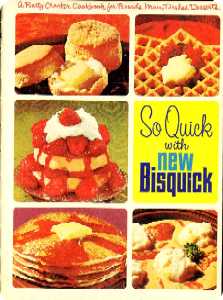
She had clipped hers, but had lost the clipping. So I found it for her in the So Quick with New Bisquick (1967, 2nd Edition, 120 pp) cookbook.

Notice that this particular recipe calls for New Bisquick (they reformulated it in the 1960s), but I just use the Original Bisquick now. Later printings of the recipe just call for plain old Bisquick.

BASIC RECIPE FOR VELVET CRUMB CAKE

1-1/2 cups New Bisquick
1/2 cup sugar
1 egg
1/2 cup cold water or milk
2 tablespoons shortening
1 teaspoon vanilla

Heat oven to 350 degrees. Grease and flour a square pan, 8x8x2 inches, or a round layer pan, 9x1-1/2 inches. In large mixer bowl, blend all ingredients on low speed 1/2 minute, scraping side and bottom of bowl frequently. Beat 4 minutes on medium speed. Pour into prepared pan. Bake 30 to 35 minutes or until top springs back when touched lightly. If desired, while warm spread cake with Broiled Topping (below) or other topping.

BROILED TOPPING

Mix 3 tbsp. soft butter, 1/3 cup brown sugar (packed), 2 tbsp. light cream, 1/2 cup coconut and 1/4 cup chopped nuts. Set oven control at broil and/or 550 degrees. Place cake about 3 inches from heat; broil about 3 minutes until mixture is nicely browned.

Note: 9-inch square pan can be used. Bake cake 25 to 30 minutes.

Variations:

VELVET CRUMB CAKE WITH BROILED PEANUT BUTTER TOPPING

Prepare Velvet Crumb Cake from basic recipe. While warm, spread cake with Peanut Butter Topping (below). Set oven control at broil and/or 550 degrees. Place cake about 3 inches from heat; broil about 3 minutes or until mixture is nicely browned.

PEANUT BUTTER TOPPING

In small bowl mix thoroughly 2 tbsp. soft butter, 1/3 cup brown sugar (packed), 2 tbsp. milk or light cream, 1/2 cup chopped peanuts and 2 tbsp. peanut butter.

ARICOT JAM CAKE

Prepare Velvet Crumb Cake from Basic Recipe. While warm, spread with 1/2 cup apricot or peach jam. Serve warm.

If you're one of those people who fix Green Bean Casserole off the Cream of Mushroom Soup can--better go clipthe recipe now. You never know when it will disappear.

Labels: , , , , ,

January 12, 2007

State Fair Recipes

Some folks collect state fair recipes and cookbooks, either from their own state or those from all fifty states.

You can find hardcover state fair cookbooks published by mainstream publishers and also smaller printed publications, sometimes published by the various state governmental agencies. Recipes from state fairs are often printed in local newspapers in the food section.

The Senior Citizens Cookie Recipes Book (1976, 24 pages) is one example of the smaller publications that can be found. It's a small cookbook with a stapled binding and was published by the State of Indiana Commission on the Aging and Aged. It was available at the 1976 Bicentennial Indiana State Fair. The Cookie Bake-Offs were held in the Senior Citizens Building and open to male or female Indiana residents who were 60 years of age or older.

The cookbook contains recipes from the 1975 Senior Citizens Cookie Bake-Off Contest held the previous year. Notice the Bicentennial colors on the cover. An entry form for the 1976 contest is in front of book. Name and location given for winners next to their recipes. Two pages in the center of the book contain photo Highlights from the Senor Citizens Building that were taken in 1975, with captions for the photos.

Some of the recipes called for name brand ingredients. Cocoa Puff Krispie Cookies was the Third Grand Prize Winner in the Final Bake-Off. It was submitted by Pearl Lee Mauck of Corydon, Indiana.

COCOA PUFF KRISPIE COOKIES

1 stick of Margarine
6 oz. package of dates
1 cup light brown sugar
1 cup chopped pecans
1/2 cup coconut
2 cups Coco-puffs
Powdered sugar or coconut

Cook margarine, dates and sugar over low heat until dates are melted (about 10 minutes), stirring all the time. Remove from heat. Add nuts, coconut, and coco-puffs.

Stir well and roll into small balls. Flatten and shape.

Roll in powdered sugar or coconut. Makes about twenty-five, or according to the size you roll.

There are 28 prize-winning recipes in all. The next recipe below was submitted by Mary Kinchlow of Indianapolis, Indiana. Although I've shown the recipe as it was printed, please note the addition of the cup of pecans at the very end of the recipe rather than higher up in the instructions.

PECAN STICKS

1 cup shortening
1 cup sugar
1 egg yolk
2 tsp. cinnamon
2-1/2 cups cake flour
1 tblsp. sugar
1 egg white, beaten stiff
1 cup chopped pecans

Cream shortening and 1 cup sugar together. Add egg yolk, cinnamon and flour. Mix. Spread 1/4 inch thick in a well-greased 10 x 15 inch pan. Add tablespoonful of sugar to beaten egg white and brush over top of dough. Cover with thick layer of pecans and press into dough. Bake 20 minutes at 350 degrees. Makes (75) 1 x 2 inch sticks. Add the cup of pecans to dough and sprinkle additional nuts on top.

You can look here to get an idea of some of the state fair recipes booklets that periodically become available. Most of the smaller booklets have been saved as part of someone's recipe or cookbook collection.

Labels: , , , ,

December 21, 2006

Baskin-Robbins Pumpkin Pie

At one point during the past week, somewhere on the roads between hospitals in Kerrville and far north Houston where we've been visiting relatives who are ill, I noticed that Baskin-Robbins had changed their logo.

While I'm not overly fond of the new look, they get points for even standing out at all amidst the jillions of other signs in the retail glut that is Texas. (We have the space to build duplicate stores and restaurants every 2.5 miles and so we do. For me, it's definitely a love/hate thing.)

Seeing the sign triggered thoughts of ice cream cakes and ice cream pies, and so I got to looking around to see if I had a recipe booklet from Baskin-Robbins.


Sure enough, I found one. The Baskin-Robbins Ice Cream Show-Off (1973, 24 pp) is a booklet containing 47 prize-winning recipes from a Baskin-Robbins-sponsored recipe contest with the same name.

The only evidence of the Baskin-Robbins logo in this publication is on the front cover, where it appears they took part of the old logo and added a prize-ribbon streamer tail to it, sort of a play on prize-winning recipes I guess.

The photograph on the front cover shows the Grand Prize winning recipe -- Heavenly Ice Cream Puff Fondue. This recipe was submitted by Laurie H. Freedman of Brooklyn, New York. The names and locations of the winning recipe contestants are shown at the end of every recipe.

The interior pages are printed on pink paper, a reflection of the familiar old company logo colors. The rear of the booklet is stamped with the name and address of one of the franchise stores (#543 in Rockford, Illinois in this case). Perhaps they were giving these booklets away as a promotional item at the individual stores.

Since we're still deep into the Christmas holiday season, I thought I'd share the following recipe from the booklet which seems fitting. This winning recipe was created by Susan T. Burtch of Richmond, Virgina.


PUMPKIN PECAN PARTY PIE

There are, of course, traditionalists among us pumpkin pie eaters. However, holiday dinners and special parties the year around call for a super special pumpkin pie. Here it is, and the grand point of difference is a Butter Pecan Ice Cream "crust".

1-1/2 quarts Baskin-Robbins Butter Pecan Ice Cream
1 cup sugar
1 cup canned pumpkin
1 teaspoon cinnamon
1/4 teaspoon each ginger, nutmeg, salt
1 cup whipping cream, whipped
1/4 cup packed light brown sugar
2 tablespoons butter
1 tablespoon water
1/2 cup chopped pecans

(Thirty minutes before preparing Ice Cream crust, put a deep 9-inch pie pan in freezer.) To make crust: Working quickly, line bottom and sides of frozen pan with Ice Cream. Do not put Ice Cream on edges of pan. Build up crust 1/2 inch above edge of pan by overlapping tablespoons of Ice Cream. Freeze at least 2 hours. Combine sugar, pumpkin, spices and salt in a saucepan; cook over low heat for 3 minutes. Cool. Reserve 1/4 cup whipped cream for garnish. Fold remaining whipped cream into pumpkin mixture. Spoon into frozen Ice Cream crust, swirling top. Freeze at least 2 hours. In small saucepan over medium heat, combine brown sugar, butter and water. Bring just to a boil, cook 1-1/2 minutes, remove from heat, stir in pecans. Cool. Spoon mixture around edge between filling and crust. Mound the 1/4 cup of reserved whipped cream in center. Freeze. Let mellow for 10 minutes in refrigerator; cut in wedges.

Makes 8 to 10 servings.

Old Fashioned Butter Pecan is one of the Permanent Flavors at Baskin Robbins so you shouldn't have any trouble finding it. The photo of the finished pie was shown on the rear cover of the recipe booklet.

Labels: , , ,